Fifty years in business for a specialist manufacturer is something to celebrate, so it’s unsurprising that Shelby American is producing some special versions of its cars to mark its golden jubilee.
50th Anniversary Editions of the Shelby GTS, GT350 and GT500 Super Snake will be available, although just fifty white and fifty black examples of each are going to be built to guarantee exclusivity.
All come with gold stripes, special wheels, six-piston front brakes, 50th anniversary badges, unique interiors, a car cover and a special vehicle identification number. And that’s about it, which is a bit underwhelming, although buyers do also get to go to the Shelby factory in Las Vegas for a handover ceremony.
Starting prices for the post-title 50th Anniversary Edition packages range from $19,995 for the GTS V6 to $59,995 for the GT500 Super Snake, plus the cost of the base Mustang.
Related posts:
Roush Stage 3 Mustang
Shelby G.T.500CR
Chitika
Showing posts with label New cars. Show all posts
Thursday, 12 January 2012
Tuesday, 10 January 2012
2013 Kia Cee’d first view
Kia has released the first image of the new 2013 Cee’d five-door hatchback, which will make its public debut at March’s Geneva Motor Show.
Nothing has been revealed about the car’s technical specifications or engine line-up, but expect the new Cee’d to be more efficient than the outgoing model.
Sales are due to begin across mainland Europe from the second quarter of 2012, and UK deliveries will commence in June. The estate version should then arrive later this year, with the sporty Procee’d three-door following sometime in 2013.
Related posts:
Electric Kia Ray launched
New Hyundai i30 revealed
Three-door Kia Picanto
Nothing has been revealed about the car’s technical specifications or engine line-up, but expect the new Cee’d to be more efficient than the outgoing model.
Sales are due to begin across mainland Europe from the second quarter of 2012, and UK deliveries will commence in June. The estate version should then arrive later this year, with the sporty Procee’d three-door following sometime in 2013.
Related posts:
Electric Kia Ray launched
New Hyundai i30 revealed
Three-door Kia Picanto
Monday, 9 January 2012
2013 Cadillac ATS revealed
The just-unveiled Cadillac ATS compact sports saloon has an important job to do for the brand.
As Don Butler, vice president of marketing for Cadillac, says, “the ATS aims to change the status quo of the European-dominated segment.” And that means it’ll have to steal customers from the BMW 3 Series, Mercedes-Benz C-Class and Audi A4... not an easy task.
The new arrival could also allow Cadillac to re-launch itself in Europe with a credible product offering. Apparently, it has been engineered to accommodate a diesel engine (although for North America three petrol engines will initially be available), and there’s even the possibility of a right-hand drive version.
Based on an all-new platform, the ATS is claimed to offer superior driving dynamics combined with lightness. Certainly, a kerb weight of less than 1,542 kg (3,400 pounds) is similar to the latest generation BMW 3 Series, and a 51% front / 49% rear mass distribution should help the car’s handling prowess. Buyers will have a choice of either rear- or all-wheel drive drivetrains.
The styling represents the latest interpretation of Cadillac’s ‘Art and Science’ design language, typified by taut, angular bodywork and strong vertical light clusters front and rear. It works well, and the long wheelbase and wide tracks give the ATS pleasing proportions.
While an on-sale date and pricing have yet to be confirmed, Cadillac has announced that as well as a standard version, the ATS will be available with Luxury, Performance and Premium Collection trim packs.
Images © GM Company.
Related posts:
2013 Cadillac XTS revealed
Cadillac confirms ELR
Cadillac teases ATS
As Don Butler, vice president of marketing for Cadillac, says, “the ATS aims to change the status quo of the European-dominated segment.” And that means it’ll have to steal customers from the BMW 3 Series, Mercedes-Benz C-Class and Audi A4... not an easy task.
The new arrival could also allow Cadillac to re-launch itself in Europe with a credible product offering. Apparently, it has been engineered to accommodate a diesel engine (although for North America three petrol engines will initially be available), and there’s even the possibility of a right-hand drive version.
Based on an all-new platform, the ATS is claimed to offer superior driving dynamics combined with lightness. Certainly, a kerb weight of less than 1,542 kg (3,400 pounds) is similar to the latest generation BMW 3 Series, and a 51% front / 49% rear mass distribution should help the car’s handling prowess. Buyers will have a choice of either rear- or all-wheel drive drivetrains.
The styling represents the latest interpretation of Cadillac’s ‘Art and Science’ design language, typified by taut, angular bodywork and strong vertical light clusters front and rear. It works well, and the long wheelbase and wide tracks give the ATS pleasing proportions.
While an on-sale date and pricing have yet to be confirmed, Cadillac has announced that as well as a standard version, the ATS will be available with Luxury, Performance and Premium Collection trim packs.
| 2013 Cadillac ATS - Preliminary Technical Specifications | |
|---|---|
| Body | |
| Type | 4-door luxury sport sedan |
| EPA vehicle class | Small car |
| Construction | Unitised welded steel body with direct-mounted front cradle and rubber-isolated, multi-link independent rear suspension |
| Drivetrain | Rear- or all-wheel drive |
| Engines | |
| 2.0 litre turbo DI VVT | |
| Displacement | 1,998 cc (122 cu. in.) |
| Bore and stroke | 86 x 86 mm (3.39 x 3.39 in.) |
| Block material | Cast aluminium |
| Cylinder material | Cast aluminium |
| Valvegear | DOHC, four-valves per cylinder, continuously variable valve timing |
| Fuel delivery | Direct high-pressure fuel injection |
| Compression ratio | 9.2:1 |
| Power | 270 bhp (201 kW / 273 PS) @ 5,300 rpm (est.) |
| Torque | 353 Nm (260 lb/ft) @ 2,400 rpm (est.) |
| Maximum engine speed | 7,000 rpm |
| Recommended fuel | Premium unleaded recommended but not required |
| Estimated fuel economy | TBD |
| 2.5 litre I-4 DI VVT | |
| Displacement | 2,457 cc (150 cu. in.) |
| Bore and stroke | 88 x 101 mm (3.46 x 3.97 in.) |
| Block material | Cast aluminium |
| Cylinder material | Cast aluminium |
| Valvegear | DOHC, four-valves per cylinder, continuously variable valve timing |
| Fuel delivery | Direct high-pressure fuel injection |
| Compression ratio | 11.4:1 |
| Power | 200 bhp (149 kW / 202 PS) @ 6,200 rpm (est.) |
| Torque | 255 Nm (188 lb/ft) @ 4,500 rpm (est.) |
| Maximum engine speed | 7,000 rpm |
| Recommended fuel | Regular unleaded |
| Estimated fuel economy | TBD |
| 3.6 litre V-6 DI VVT | |
| Displacement | 3,564 cc (217 cu. in.) |
| Bore and stroke | 94 x 85.6 mm (3.7 x 3.37 in.) |
| Block material | Cast aluminium |
| Cylinder material | Cast aluminium |
| Valvegear | DOHC, four-valves per cylinder, continuously variable valve timing |
| Fuel delivery | Direct high-pressure fuel injection |
| Compression ratio | 11.5:1 |
| Power | 320 bhp (238 kW / 324 PS) @ 6,800 rpm (est.) |
| Torque | 362 Nm (267 lb/ft) @ 4,900 rpm (est.) |
| Maximum engine speed | 7,200 rpm |
| Recommended fuel | Regular unleaded or E85 |
| Estimated fuel economy | TBD |
| Transmissions | |
| Tremec M3L TR3160 | |
| Type | Fully synchronized six-speed manual with single overdrive |
| Gear ratios (:1) | First: 4.12; second: 2.62; third: 1.81; fourth: 1.30; fifth: 1.00; sixth: 0.80; reverse: 3.75 |
| Final drive ratio | 3.27 |
| Hydra-Matic 6L45 | |
| Type | Six-speed, electronically controlled, automatic overdrive with torque converter clutch |
| Gear ratios (:1) | First: 4.06; second: 2.37; third: 1.55; fourth: 1.16; fifth: 0.85; sixth: 0.67; reverse: 3.20 |
| Final drive ratio | 3.27 (2.5L, 3.6L); 3.45 (2.0T) |
| Chassis | |
| Differential | Open (FE2 suspension); mechanical limited-slip (FE3 suspension) |
| Front suspension | MacPherson-type with dual lower ball joints and direct-acting stabilizer bar; Magnetic Ride Control (FE3) |
| Rear suspension | Independent five-link with monotube shock absorbers; Magnetic Ride Control (FE3) |
| Steering type | ZF rack-mounted electric, power-assisted and variable assist |
| Steering ratio | FE2: 16.8:1; FE3: 15.3:1 |
| Steering turns, lock-to-lock | FE2: 3.16; FE3: 2.86 |
| Turning circle | FE2 RWD: 11.09 m / 36.38 ft; FE3 RWD: 10.97 m / 35.99 ft; FE2 AWD: 11.60 m / 38.05 ft |
| Chassis control | Four-channel StabiliTrak with brake assist and traction control |
| Brakes | |
| Type | Four-wheel disc with sliding calipers on base; four-channel ABS/TCS with DRP; Brembo brakes with fixed calipers on Luxury, Performance and Premium collections |
| Disc treatment | Ferritic Nitro Carbunized process for corrosion resistance |
| Disc size and thickness, standard | Front 300 x 26 mm (11.8 x 1.02 in.); rear 315 x 23 mm (12.4 x 0.90 in.) |
| Disc size and thickness, up-level | Front 321 x 30 mm (12.6 x 1.18 in.); rear 315 x 23 mm (12.4 x 0.90 in.) |
| Wheels / Tyres | |
| Wheel sizes and types | 17 x 8-inch aluminium (painted); 17 x 8-inch aluminium (polished); 18 x 8-inch aluminium (machined-face); 18 x 8-inch aluminium (polished) |
| Tyre sizes and types | P225/45R17 90H all-season; P225/45R17 90V run-flat all-season; 225/40R18 92V run-flat all-season; 225/40R18 88W / 255/35R18 90W run-flat summer-only; 225/35ZR19 88Y / 255/30ZR19 91Y run-flat all-season (LPO) |
| Exterior dimensions | |
| Wheelbase | 2,775 mm (109.3 in.) |
| Length | 4,643 mm (182.8 in.) |
| Height | 1,421 mm (55.9 in.) |
| Width | 1,805 mm (71.1 in.) |
| Track | Front 1,512 mm (59.5 in.); rear 1,548 mm (60.9 in.) |
| Approx. curb weight | Less than 1,542 kg (3,400 lb) |
| Weight distribution | 51 % front / 49 % rear |
| Interior dimensions | |
| Legroom | Front 1,079 mm (42.5 in.); rear 851 mm (33.5 in.) |
| Headroom | Front 980 mm (38.6 in.); rear 935 mm (36.8 in.) |
| Shoulder room | Front 1,345 mm (55.2 in.); rear 1,370 mm (53.9 in.) |
| Hip room | Front 1,345 mm (53.0 in.); rear 1,328 mm (52.3 in.) |
| Seating capacity | 2 front / 3 rear |
| EPA passenger volume | 2,573 litres (90.9 cu. ft.) |
| EPA trunk volume | 290 litres (10.2 cu. ft.) |
| Capacities | |
| Trailer towing maximum | 454 kg (1,000 lb) (3.6L) |
| Fuel tank | 60.5 litres (16 US gallons) |
| Engine oil | TBD |
| Cooling system | 2.0T 7.7 litres (8.1 qt.); 2.5L 6.7 litres (7.1 qt.); 3.6L 10.4 litres (11.0 qt.) |
Images © GM Company.
Related posts:
2013 Cadillac XTS revealed
Cadillac confirms ELR
Cadillac teases ATS
Sunday, 8 January 2012
2013 Dodge Dart leaked
Just ahead of its debut at the North American International Auto Show in Detroit, images of the all-new 2013 Dodge Dart compact have been leaked.
Their emergence follows Dodge’s teaser campaign last month, so perhaps we’ll never know how ‘official’ the release of these latest pictures is.
Whatever, it seems that the heavily-cropped teaser shots really didn’t do the Dart’s styling justice.
Thanks to a low, wide stance, a prominent rising beltline along the side and a neat arrangement for the headlights and Dodge crosshair grille, it manages to look pretty good from just about any angle. Certainly in terms of design, the Dart moves things on immeasurably from its Caliber predecessor.
Based on a stretched and widened Alfa Romeo Giulietta platform - known as Compact U.S. Wide (CUSW) - the Dart is going to be available with a choice of three four-cylinder petrol engines. Two of those feature Fiat’s MultiAir valvegear technology, which should mean significantly improved fuel consumption and emissions.
Related post:
2013 Dodge Dart teased
![]() |
| 2013 Dodge Dart. Scroll down for more images. |
Their emergence follows Dodge’s teaser campaign last month, so perhaps we’ll never know how ‘official’ the release of these latest pictures is.
Whatever, it seems that the heavily-cropped teaser shots really didn’t do the Dart’s styling justice.
Thanks to a low, wide stance, a prominent rising beltline along the side and a neat arrangement for the headlights and Dodge crosshair grille, it manages to look pretty good from just about any angle. Certainly in terms of design, the Dart moves things on immeasurably from its Caliber predecessor.
Based on a stretched and widened Alfa Romeo Giulietta platform - known as Compact U.S. Wide (CUSW) - the Dart is going to be available with a choice of three four-cylinder petrol engines. Two of those feature Fiat’s MultiAir valvegear technology, which should mean significantly improved fuel consumption and emissions.
Related post:
2013 Dodge Dart teased
Saturday, 7 January 2012
Volt crash safety enhanced
Clearly keen not to put off potential purchasers or existing owners, General Motors has been swift in upgrading the crash performance of its Chevrolet Volt and Vauxhall / Opel Ampera range extenders.
The changes are designed to provide additional protection to the battery pack, in order to prevent a post-impact electrical fire.
They come in response to a crash test that was carried out in the United States by the National Highway Traffic Safety Administration back in May 2011. That test caused battery coolant to leak, which in turn resulted in an electrical fire three weeks later. The NHTSA then replicated the situation under laboratory conditions, which caused a battery pack fire six days after.
Included in the modifications are a sensor for the battery coolant reservoir that monitors coolant levels, a tamper-resistant bracket for the reservoir to prevent coolant overfill and additional structural strengthening that should provide extra side-impact protection for the battery pack.
As well as being incorporated into the production process, the enhancements will also be retro-fitted to customers’ cars.
Image © GM Company.
Related posts:
Holden Volt tech specs
Volt is Car of the Year
The changes are designed to provide additional protection to the battery pack, in order to prevent a post-impact electrical fire.
They come in response to a crash test that was carried out in the United States by the National Highway Traffic Safety Administration back in May 2011. That test caused battery coolant to leak, which in turn resulted in an electrical fire three weeks later. The NHTSA then replicated the situation under laboratory conditions, which caused a battery pack fire six days after.
Included in the modifications are a sensor for the battery coolant reservoir that monitors coolant levels, a tamper-resistant bracket for the reservoir to prevent coolant overfill and additional structural strengthening that should provide extra side-impact protection for the battery pack.
As well as being incorporated into the production process, the enhancements will also be retro-fitted to customers’ cars.
Image © GM Company.
Related posts:
Holden Volt tech specs
Volt is Car of the Year
Thursday, 5 January 2012
Dacia Lodgy MPV first pics
Dacia has revealed its new Lodgy MPV, which is due to debut at March’s Geneva Motor Show.
Specification details are sketchy, but Dacia has confirmed that the Lodgy’s dodgy name derives from ‘lodge’, five- or seven-seat versions will be available and its overall length is 4,500 mm (about 14’ 9”).
That makes it just a tad shorter than the Grand Scénic from parent firm Renault, although it’s unclear whether both models share the same platform. Certainly they manage to look different which, judging by the images, isn’t necessarily a good thing for the Dacia.
While the Grand Scénic manages to appear fairly neat and stylish, the Lodgy looks a bit too van-like and its awkward proportions aren’t helped by seemingly tiny wheels. Going by the first view it’s a disappointment, especially as some recent Dacia designs (such as the Duster) have managed to be both distinctive and appealing. Perhaps the Lodgy will be better in the metal…
The Dacia brand is scheduled to launch in the UK in a year’s time, so there’s a chance that in time the Lodgy MPV could end up on sale here.
Related post:
Dacia Duster No Limit
Specification details are sketchy, but Dacia has confirmed that the Lodgy’s dodgy name derives from ‘lodge’, five- or seven-seat versions will be available and its overall length is 4,500 mm (about 14’ 9”).
That makes it just a tad shorter than the Grand Scénic from parent firm Renault, although it’s unclear whether both models share the same platform. Certainly they manage to look different which, judging by the images, isn’t necessarily a good thing for the Dacia.
While the Grand Scénic manages to appear fairly neat and stylish, the Lodgy looks a bit too van-like and its awkward proportions aren’t helped by seemingly tiny wheels. Going by the first view it’s a disappointment, especially as some recent Dacia designs (such as the Duster) have managed to be both distinctive and appealing. Perhaps the Lodgy will be better in the metal…
The Dacia brand is scheduled to launch in the UK in a year’s time, so there’s a chance that in time the Lodgy MPV could end up on sale here.
Related post:
Dacia Duster No Limit
Monday, 2 January 2012
75 years of the Morgan 4/4
The 4/4 is a seminal model in Morgan’s history, because when it first appeared back in 1936 it was the company’s first four-wheel car.
Still going strong, albeit with a multitude of changes and many different engines along the way, the 4/4 75th Anniversary Edition has now been created to celebrate its remarkable longevity.
Available in a choice of Sport Black, Sport Red or Old English White, the paintwork is complemented by a black hood and black 15-inch wire wheels. There are also matt black bonnet stripes with ‘4/4’ and ‘75’ motifs, although these look a bit incongruous and whether they will appeal to Morgan traditionalists remains to be seen.
On the inside, black leather upholstery and matching carpets come as standard, while the dashboard is polished tawny ash. Completing the interior package is a wood-rimmed Moto-Lita steering wheel.
But the enhancements for the special version aren’t only cosmetic, as it also features the larger-capacity 2.0 Ford engine from the Plus 4, instead of the usual 1.6 litre unit.
This upgrade means the 4/4 75th Anniversary Edition can boast 143 bhp (106 Nm / 145 PS) and 187 Nm (140 lb/ft) of peak torque. With a dry weight of just 920 kg (2,028 lbs), that’s enough for a 0-62 mph (100 km/h) time of 7.2 seconds, although the 1930s aerodynamics restrict top speed to a fairly modest 118 mph (189 km/h).
Efficiency is certainly right up to date though, and combined cycle fuel consumption is a very respectable 39.0 mpg (7.2 l/100km). Likewise, CO2 emissions are 162 g/km - a figure that actually betters the current 1.8 litre Mazda MX-5.
The Morgan 4/4 75th Anniversary Edition is priced at £38,750 in the UK, which includes VAT but excludes on the road charges.
Related post:
Morgan Threewheeler
Still going strong, albeit with a multitude of changes and many different engines along the way, the 4/4 75th Anniversary Edition has now been created to celebrate its remarkable longevity.
![]() |
| 2012 Morgan 4/4 75th Anniversary Edition. Scroll down for more images. |
Available in a choice of Sport Black, Sport Red or Old English White, the paintwork is complemented by a black hood and black 15-inch wire wheels. There are also matt black bonnet stripes with ‘4/4’ and ‘75’ motifs, although these look a bit incongruous and whether they will appeal to Morgan traditionalists remains to be seen.
On the inside, black leather upholstery and matching carpets come as standard, while the dashboard is polished tawny ash. Completing the interior package is a wood-rimmed Moto-Lita steering wheel.
But the enhancements for the special version aren’t only cosmetic, as it also features the larger-capacity 2.0 Ford engine from the Plus 4, instead of the usual 1.6 litre unit.
This upgrade means the 4/4 75th Anniversary Edition can boast 143 bhp (106 Nm / 145 PS) and 187 Nm (140 lb/ft) of peak torque. With a dry weight of just 920 kg (2,028 lbs), that’s enough for a 0-62 mph (100 km/h) time of 7.2 seconds, although the 1930s aerodynamics restrict top speed to a fairly modest 118 mph (189 km/h).
Efficiency is certainly right up to date though, and combined cycle fuel consumption is a very respectable 39.0 mpg (7.2 l/100km). Likewise, CO2 emissions are 162 g/km - a figure that actually betters the current 1.8 litre Mazda MX-5.
The Morgan 4/4 75th Anniversary Edition is priced at £38,750 in the UK, which includes VAT but excludes on the road charges.
Related post:
Morgan Threewheeler
Saturday, 31 December 2011
Electric Kia Ray launched
Kia has become the latest manufacturer to add an electric vehicle to its range. The Ray EV is based on the recently introduced petrol-powered Ray mini-MPV and, unusually given their very different technologies, both models will share the same production line.
Drive comes from a 67 bhp (50 kW / 68 PS) electric motor connected to an automatic transmission. With 167 Nm (123 lb/ft) of torque available, zero to 62 mph (100 km/h) takes a leisurely 15.9 seconds, while the Ray EV’s top speed is 81 mph (130 km/h).
Performance is likely to be less important than range and recharge times to potential users, though. The 16.4 kWh lithium ion polymer battery pack, which sits beneath the rear seat and cabin floor, is claimed to be good for 86 miles (139 km) before it needs topping up. That process takes six hours using a normal domestic electricity supply, or a much more practical 25 minutes in fast-charge mode.
The battery is claimed to be lighter and offer better energy density than competitor systems. However, its expected lifespan is only ten years, which could see a lot of cars getting scrapped prematurely if the replacement battery pack cost turns out to be prohibitive.
Visually, not much distinguishes the Ray EV from its petrol equivalent. There’s a flap in the front grille for the recharging socket, aerodynamic 14” alloy wheels and some door graphics proclaiming the car’s green credentials. On the inside, the instruments have been changed, and there’s a special navigation system that shows the 500 charging station locations that currently exist across South Korea.
But there’s no point in trying to place an order for one with your local Kia dealer. That’s because for now the Ray EV will only be on sale in South Korea, and all of 2012’s production run of 2,500 units has been allocated to various government and public sector departments.
Related posts:
Three-door Kia Picanto
Kia Naimo electric concept
Drive comes from a 67 bhp (50 kW / 68 PS) electric motor connected to an automatic transmission. With 167 Nm (123 lb/ft) of torque available, zero to 62 mph (100 km/h) takes a leisurely 15.9 seconds, while the Ray EV’s top speed is 81 mph (130 km/h).
Performance is likely to be less important than range and recharge times to potential users, though. The 16.4 kWh lithium ion polymer battery pack, which sits beneath the rear seat and cabin floor, is claimed to be good for 86 miles (139 km) before it needs topping up. That process takes six hours using a normal domestic electricity supply, or a much more practical 25 minutes in fast-charge mode.
The battery is claimed to be lighter and offer better energy density than competitor systems. However, its expected lifespan is only ten years, which could see a lot of cars getting scrapped prematurely if the replacement battery pack cost turns out to be prohibitive.
Visually, not much distinguishes the Ray EV from its petrol equivalent. There’s a flap in the front grille for the recharging socket, aerodynamic 14” alloy wheels and some door graphics proclaiming the car’s green credentials. On the inside, the instruments have been changed, and there’s a special navigation system that shows the 500 charging station locations that currently exist across South Korea.
But there’s no point in trying to place an order for one with your local Kia dealer. That’s because for now the Ray EV will only be on sale in South Korea, and all of 2012’s production run of 2,500 units has been allocated to various government and public sector departments.
Related posts:
Three-door Kia Picanto
Kia Naimo electric concept
Friday, 30 December 2011
Escalade security improves
According to the National Insurance Crime Bureau, the Cadillac Escalade doesn’t make the top ten list of most stolen vehicles in the United States.
However, that doesn’t necessarily mean that the big SUV isn’t an attractive target for criminal types, so Cadillac has decided to upgrade the Escalade’s security features for 2012.
The improvements include a strengthened steering column lock, an alarm-linked inclination sensor to detect when the vehicle is being towed or lifted, the PASS Key 3+ ignition key encryption system, better wheel locks and a shock sensor that reacts to sudden movements, for instance when a window is smashed.
All useful items then, even if it’s a bit surprising that such basic measures aren’t already fitted to the Escalade.
And the thieves’ favourite? That’ll be the 1994 Honda Accord:
Image © GM Company.
Related posts:
2013 Cadillac XTS revealed
Cadillac confirms ELR
However, that doesn’t necessarily mean that the big SUV isn’t an attractive target for criminal types, so Cadillac has decided to upgrade the Escalade’s security features for 2012.
The improvements include a strengthened steering column lock, an alarm-linked inclination sensor to detect when the vehicle is being towed or lifted, the PASS Key 3+ ignition key encryption system, better wheel locks and a shock sensor that reacts to sudden movements, for instance when a window is smashed.
All useful items then, even if it’s a bit surprising that such basic measures aren’t already fitted to the Escalade.
And the thieves’ favourite? That’ll be the 1994 Honda Accord:
| Top 10: Most Stolen Vehicles in the United States | |
|---|---|
| Position | Model |
| 1 | 1994 Honda Accord |
| 2 | 1995 Honda Civic |
| 3 | 1991 Toyota Camry |
| 4 | 1999 Chevrolet Pickup (Full Size) |
| 5 | 1997 Ford F150 Series / Pickup |
| 6 | 2004 Dodge Ram |
| 7 | 2000 Dodge Caravan |
| 8 | 1994 Acura Integra |
| 9 | 2002 Ford Explorer |
| 10 | 1999 Ford Taurus |
| Data from the 2010 National Insurance Crime Bureau Hot Wheels report. | |
Image © GM Company.
Related posts:
2013 Cadillac XTS revealed
Cadillac confirms ELR
Thursday, 22 December 2011
Limited edition A1 quattro
Audi seems somewhat reluctant to use the S1 nameplate, but perhaps the new limited edition A1 quattro is a precursor to just such a model?
Only 333 examples are going to be built, but the bad news for enthusiasts in the UK is that - for now at least - they are all destined to be left-hand drive. On the face of it then, a strange decision by Audi to ignore one of its most important European markets…
That the A1 quattro appears to be an appealing package makes the situation even worse. Incorporating permanent all-wheel drive, a 252 bhp (188 kW / 256 PS) 2.0 litre TFSI engine and a six-speed manual transmission into a supermini chassis is a guaranteed recipe for brisk performance.
And the figures bear that out: acceleration from zero to 62 mph (100 km/h) is claimed to take just 5.7 seconds, while the top speed is 152 mph (245 km/h). Fuel economy isn’t great though, with the A1 quattro expected to achieve a mediocre combined cycle figure of around 33.2 mpg (8.5 l/100km).
There certainly should be no problem distinguishing the A1 quattro from lesser variants. Only available in Glacier White with a contrasting high-gloss black roof, it also features a prominent rear spoiler, polished exhaust pipes and unique front and rear bumpers. Completing the package are red-painted ‘wings’ that sit within the headlights and white 18-inch ‘Turbine’ design alloy wheels.
The inside is dominated by ‘S’ design front sports seats that come trimmed in black Nappa leather with red stitching. That colour scheme is carried over to the chunky flat-bottomed sports steering wheel, which also bears the car’s build number. Standard equipment is generous and includes cruise control, park distance control, automatic air conditioning, satellite navigation, a CD changer, DAB radio and Bluetooth connectivity.
Sales of the Audi A1 Quattro are due to begin sometime in the second half of 2012, but pricing has yet to be confirmed.
Related posts:
99 g/km diesel Audi A1
Audi A1 clubsport Quattro
Audi A1 1.4 TFSI, not S1
Only 333 examples are going to be built, but the bad news for enthusiasts in the UK is that - for now at least - they are all destined to be left-hand drive. On the face of it then, a strange decision by Audi to ignore one of its most important European markets…
![]() |
| 2012 Audi A1 quattro. Scroll down for more images. |
That the A1 quattro appears to be an appealing package makes the situation even worse. Incorporating permanent all-wheel drive, a 252 bhp (188 kW / 256 PS) 2.0 litre TFSI engine and a six-speed manual transmission into a supermini chassis is a guaranteed recipe for brisk performance.
And the figures bear that out: acceleration from zero to 62 mph (100 km/h) is claimed to take just 5.7 seconds, while the top speed is 152 mph (245 km/h). Fuel economy isn’t great though, with the A1 quattro expected to achieve a mediocre combined cycle figure of around 33.2 mpg (8.5 l/100km).
There certainly should be no problem distinguishing the A1 quattro from lesser variants. Only available in Glacier White with a contrasting high-gloss black roof, it also features a prominent rear spoiler, polished exhaust pipes and unique front and rear bumpers. Completing the package are red-painted ‘wings’ that sit within the headlights and white 18-inch ‘Turbine’ design alloy wheels.
The inside is dominated by ‘S’ design front sports seats that come trimmed in black Nappa leather with red stitching. That colour scheme is carried over to the chunky flat-bottomed sports steering wheel, which also bears the car’s build number. Standard equipment is generous and includes cruise control, park distance control, automatic air conditioning, satellite navigation, a CD changer, DAB radio and Bluetooth connectivity.
Sales of the Audi A1 Quattro are due to begin sometime in the second half of 2012, but pricing has yet to be confirmed.
Related posts:
99 g/km diesel Audi A1
Audi A1 clubsport Quattro
Audi A1 1.4 TFSI, not S1
Tuesday, 20 December 2011
2013 Chevrolet Sonic RS
Despite its sporty appearance and turbocharged engine, the 2013 Chevrolet Sonic RS isn’t exactly a hot hatch.
Not that that’s the claim, though. To quote Chris Perry, Vice President of Global Chevrolet Marketing, the new arrival “takes the Sonic’s great design and latest connectivity features and combines them with a more performance-oriented look and feel.”
So it’s unsurprising that outputs from the 1.4 litre Ecotec engine could best be described as adequate: maximum power is 138 bhp (103 kW / 139 PS), while peak torque is 200 Nm (148 lb/ft). But Chevrolet probably realises that many target customers are going to focus on economy as much as performance, although no figures have been released that would indicate how well that particular balance has been achieved.
For enhanced driving dynamics, the suspension is lowered and stiffened, while stopping ability should be improved thanks to the disc brakes that are fitted both front and rear.
The RS treatment also means a host of visual tweaks that work well on the already smart Sonic. Available as a five-door only, changes from the regular versions include a body kit, five-spoke 17” alloy wheels, a rear spoiler, a unique grille and a different finish for the door mirror caps.
Among the special interior features are sports seats, a thick-rimmed sports steering wheel and aluminium pedals. Chevrolet’s MyLink infotainment system also comes as standard. Based around a seven-inch touch screen and Bluetooth connectivity, this allows the driver to load music, listen to Pandora and Stitcher Internet radio and access navigation functions via their smart phone.
The Chevrolet Sonic RS will be seen in public for the first time at January’s North American International Auto Show. Sales are due to begin in late 2012.
Images © GM Company.
Related post:
2012 NACTOY finalists
Not that that’s the claim, though. To quote Chris Perry, Vice President of Global Chevrolet Marketing, the new arrival “takes the Sonic’s great design and latest connectivity features and combines them with a more performance-oriented look and feel.”
So it’s unsurprising that outputs from the 1.4 litre Ecotec engine could best be described as adequate: maximum power is 138 bhp (103 kW / 139 PS), while peak torque is 200 Nm (148 lb/ft). But Chevrolet probably realises that many target customers are going to focus on economy as much as performance, although no figures have been released that would indicate how well that particular balance has been achieved.
For enhanced driving dynamics, the suspension is lowered and stiffened, while stopping ability should be improved thanks to the disc brakes that are fitted both front and rear.
The RS treatment also means a host of visual tweaks that work well on the already smart Sonic. Available as a five-door only, changes from the regular versions include a body kit, five-spoke 17” alloy wheels, a rear spoiler, a unique grille and a different finish for the door mirror caps.
Among the special interior features are sports seats, a thick-rimmed sports steering wheel and aluminium pedals. Chevrolet’s MyLink infotainment system also comes as standard. Based around a seven-inch touch screen and Bluetooth connectivity, this allows the driver to load music, listen to Pandora and Stitcher Internet radio and access navigation functions via their smart phone.
The Chevrolet Sonic RS will be seen in public for the first time at January’s North American International Auto Show. Sales are due to begin in late 2012.
Images © GM Company.
Related post:
2012 NACTOY finalists
Saturday, 17 December 2011
Suzuki Kizashi will struggle
Suzuki’s new flagship, the Kizashi saloon, has a lot in its favour. For example, the styling’s great, on-demand all-wheel drive comes as standard, equipment levels are generous and prices - which start from £21,995 - are competitive.
However, all of that is likely to be ignored by most potential customers because of the Kizashi’s oddball powertrain. The only engine available is a petrol 2.4 litre four-cylinder from the Grand Vitara SUV, and it’s connected to a continuously variable transmission.
In Europe at least, cars in this sector have to have a credible diesel option if they’re not to remain firmly stuck to the showroom floor. Unfortunately for Suzuki, the Kizashi’s figures clearly illustrate why that’s the case.
A power output of 175 bhp (130 kW / 178 PS) and 230 Nm (169 lb/ft) of peak torque aren’t anything special, and neither are a 0-62 mph (100 km/h) time of 8.8 seconds and a top speed of 127 mph (204 km/h).
But that mediocre performance is nothing compared to its poor efficiency: combined cycle fuel consumption is only 34.0 mpg (8.3 l/100km), while CO2 emissions are a horrendously high 191 g/km.
That puts the Suzuki in Band J for UK road tax purposes, meaning a hefty £245 annual charge. It also gives it a company car tax percentage of 27%, which will probably be enough to put off most business users.
Unsurprisingly, Suzuki’s aspirations for the Kizashi are appropriately modest, although ironically its rarity might be an attraction for some.
Nevertheless, the case for buying it appears thin when comparison is made to more mainstream competitors, such as the 160 bhp (119 kW / 163 PS) 2.0 litre diesel Mondeo.
The Ford has similar performance to the Suzuki, with 0-62 mph taking 8.9 seconds and a top speed of 137 mph (220 km/h), yet its combined fuel consumption is 53.3 mpg (5.3 l/100km).
Just as importantly, the Mondeo produces 139 g/km of CO2 which results in a Band E road tax charge of £115 per year, and its company car tax percentage is a much more reasonable 19%.
Related posts:
New Suzuki Swift Sport
Diesel Suzuki Swift DDiS
However, all of that is likely to be ignored by most potential customers because of the Kizashi’s oddball powertrain. The only engine available is a petrol 2.4 litre four-cylinder from the Grand Vitara SUV, and it’s connected to a continuously variable transmission.
In Europe at least, cars in this sector have to have a credible diesel option if they’re not to remain firmly stuck to the showroom floor. Unfortunately for Suzuki, the Kizashi’s figures clearly illustrate why that’s the case.
A power output of 175 bhp (130 kW / 178 PS) and 230 Nm (169 lb/ft) of peak torque aren’t anything special, and neither are a 0-62 mph (100 km/h) time of 8.8 seconds and a top speed of 127 mph (204 km/h).
But that mediocre performance is nothing compared to its poor efficiency: combined cycle fuel consumption is only 34.0 mpg (8.3 l/100km), while CO2 emissions are a horrendously high 191 g/km.
That puts the Suzuki in Band J for UK road tax purposes, meaning a hefty £245 annual charge. It also gives it a company car tax percentage of 27%, which will probably be enough to put off most business users.
Unsurprisingly, Suzuki’s aspirations for the Kizashi are appropriately modest, although ironically its rarity might be an attraction for some.
Nevertheless, the case for buying it appears thin when comparison is made to more mainstream competitors, such as the 160 bhp (119 kW / 163 PS) 2.0 litre diesel Mondeo.
The Ford has similar performance to the Suzuki, with 0-62 mph taking 8.9 seconds and a top speed of 137 mph (220 km/h), yet its combined fuel consumption is 53.3 mpg (5.3 l/100km).
Just as importantly, the Mondeo produces 139 g/km of CO2 which results in a Band E road tax charge of £115 per year, and its company car tax percentage is a much more reasonable 19%.
Related posts:
New Suzuki Swift Sport
Diesel Suzuki Swift DDiS
Wednesday, 14 December 2011
2013 Dodge Dart teased
8 January 2012 Update:
To see a full view of the 2013 Dodge Dart, please click here.
For its new compact car, Dodge has decided to revive the Dart nameplate. It’s also going to be using a stretched and widened Alfa Romeo Giulietta platform - known as Compact U.S. Wide (CUSW) - to underpin it, emphasising the ever-closer links between Fiat and Chrysler Group products.
The 2013 Dart is due to be revealed at next month’s North American International Auto Show in Detroit, but in the meantime a few images have been released by Dodge as part of a teaser campaign.
These show the trademark crosshairs front grille, flanked by distinctive projector headlights. At the back, there’s a Charger-inspired ‘racetrack’ LED light array and prominent dual exhausts.
For the interior, decent soft-touch materials are promised, while an 8.4” Uconnect touch screen and a customisable Thin Film Transistor (TFT) gauge cluster will be available. The Dart gets ten airbags as standard, and it’s claimed to have best-in-class hip and shoulder room.
A choice of three four-cylinder petrol engines is going to be offered, two of which come with Fiat’s MultiAir valvegear technology for significantly improved fuel consumption and emissions.
Related posts:
Challenger Yellow Jacket
Charger SRT8 Super Bee
2012 Dodge Charger SRT8
Monday, 12 December 2011
New Bentley Continental V8
Bentley has gone green (sort of) by announcing the Continental GT and GTC V8.
Due to be revealed at the North American International Auto Show in January, the new twin-turbo engine displaces 4.0 litres and produces 500 bhp (373 kW / 507 PS) and 660 Nm (487 lb/ft) of peak torque.
Tellingly, those outputs aren’t too far behind the 567 bhp (423 kW / 575 PS) and 700 Nm (516 lb/ft) of the existing 6.0 W12 Continental, which remains in the range.
It’s a similar story with performance: the V8’s eight-speed automatic transmission and all-wheel drive system allow for a 4.6 second 0-60 mph (96 km/h) time and a top speed of 188 mph (303 km/h).
By contrast, the W12 takes 4.4 seconds to get to 60 mph and can reach 198 mph (318 km/h). On that basis at least, it seems there’s not much difference between the two models.
But it’s fuel consumption and emissions where the new V8 is really meant to score over its larger-engine sibling - indeed, Bentley is claiming that the 4.0 litre powertrain fulfils the firm’s promise to deliver a 40 per cent improvement in efficiency.
Certainly that seems to be the case regarding CO2 emissions, as the V8 GT coupé achieves 246 g/km compared to the W12’s 384 g/km.
For some reason, fuel consumption figures won’t be released until early next year. However, the Continental V8 is supposed to be able to drive over 500 miles (800 km) on a single tank of fuel, thanks in part to a V4 mode that kicks in when cruising or under light throttle loads, low friction engine internals and an energy regeneration system.
Assuming the V8’s tank size remains at 20 gallons (90 litres), that would give an average consumption figure of around 25 mpg (11.3 l/100km). So, with the Continental W12 managing just 17.1 mpg (16.5 l/100km) on the EU combined cycle, it looks like that 40 per cent target could well be met.
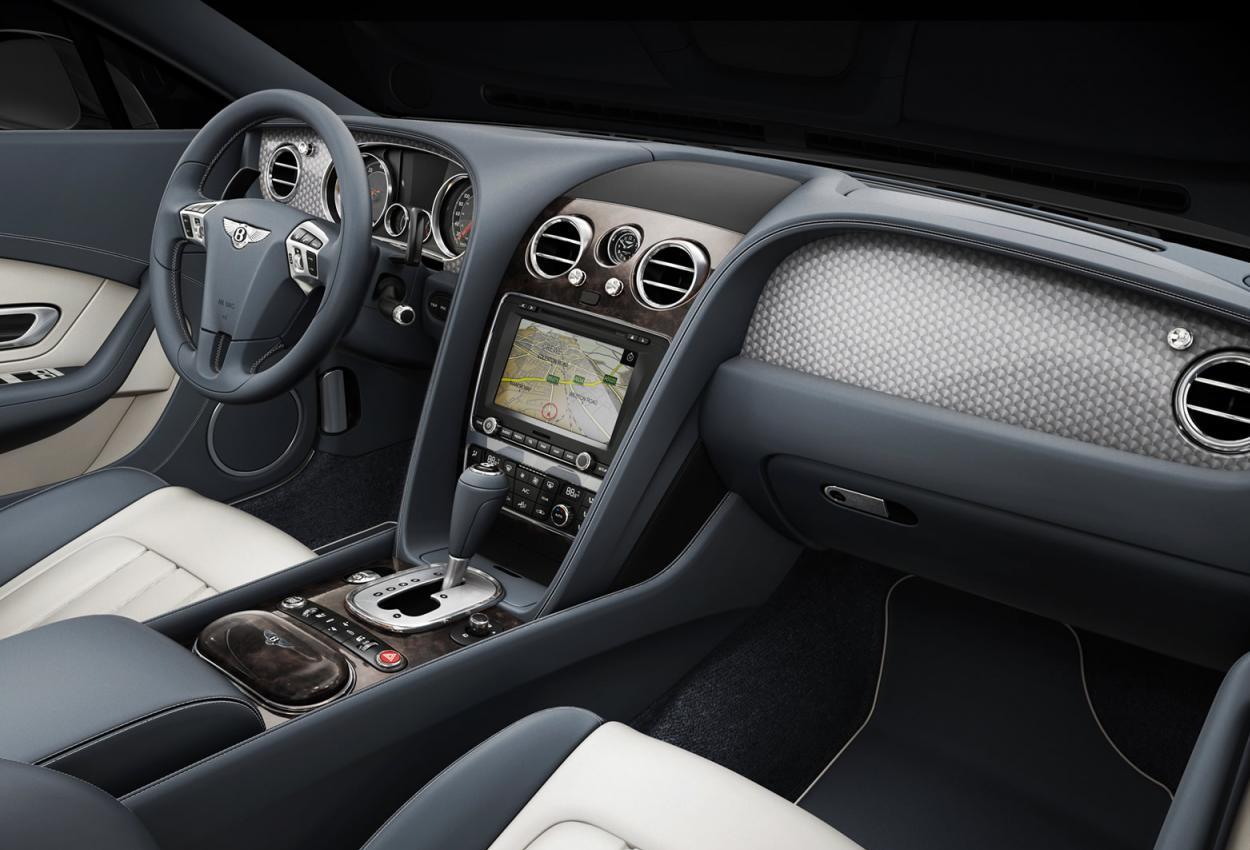
The V8 version is distinguished by its gloss black grille, red enamel Bentley badges, twin ‘figure eight’ exhaust pipes, revised front bumper design and dark rear lower valence. On the inside, there’s a shorter centre console, Eliade cloth headlining and a unique Dark Fiddleback Eucalyptus wood veneer.
Pricing has yet to be confirmed.
Related post:
Bentley Mulliner Styling
Due to be revealed at the North American International Auto Show in January, the new twin-turbo engine displaces 4.0 litres and produces 500 bhp (373 kW / 507 PS) and 660 Nm (487 lb/ft) of peak torque.
Tellingly, those outputs aren’t too far behind the 567 bhp (423 kW / 575 PS) and 700 Nm (516 lb/ft) of the existing 6.0 W12 Continental, which remains in the range.
It’s a similar story with performance: the V8’s eight-speed automatic transmission and all-wheel drive system allow for a 4.6 second 0-60 mph (96 km/h) time and a top speed of 188 mph (303 km/h).
By contrast, the W12 takes 4.4 seconds to get to 60 mph and can reach 198 mph (318 km/h). On that basis at least, it seems there’s not much difference between the two models.
But it’s fuel consumption and emissions where the new V8 is really meant to score over its larger-engine sibling - indeed, Bentley is claiming that the 4.0 litre powertrain fulfils the firm’s promise to deliver a 40 per cent improvement in efficiency.
Certainly that seems to be the case regarding CO2 emissions, as the V8 GT coupé achieves 246 g/km compared to the W12’s 384 g/km.
For some reason, fuel consumption figures won’t be released until early next year. However, the Continental V8 is supposed to be able to drive over 500 miles (800 km) on a single tank of fuel, thanks in part to a V4 mode that kicks in when cruising or under light throttle loads, low friction engine internals and an energy regeneration system.
Assuming the V8’s tank size remains at 20 gallons (90 litres), that would give an average consumption figure of around 25 mpg (11.3 l/100km). So, with the Continental W12 managing just 17.1 mpg (16.5 l/100km) on the EU combined cycle, it looks like that 40 per cent target could well be met.
The V8 version is distinguished by its gloss black grille, red enamel Bentley badges, twin ‘figure eight’ exhaust pipes, revised front bumper design and dark rear lower valence. On the inside, there’s a shorter centre console, Eliade cloth headlining and a unique Dark Fiddleback Eucalyptus wood veneer.
Pricing has yet to be confirmed.
Related post:
Bentley Mulliner Styling
Sunday, 11 December 2011
Škoda Vision D - more pics
Škoda first revealed the Octavia-sized Vision D concept at March’s Geneva Motor Show.
Now more images have been released, perhaps as a reminder that the Vision D’s styling represents the Czech brand’s future design language.
Typified by a long wheelbase and short overhangs (plus the new grille shape that’s already been seen on the new Citigo city car), it suggests that upcoming Škoda models could potentially look very sleek and elegant.
The rumour is that the Vision D will form the basis for the next-generation Octavia. If so, the only hope is that its dynamic appearance doesn’t get too diluted in the transition from concept to production car.
Related posts:
Škoda reveals the Citigo
Škoda MissionL concept
Škoda Vision D at Geneva
Now more images have been released, perhaps as a reminder that the Vision D’s styling represents the Czech brand’s future design language.
Typified by a long wheelbase and short overhangs (plus the new grille shape that’s already been seen on the new Citigo city car), it suggests that upcoming Škoda models could potentially look very sleek and elegant.
The rumour is that the Vision D will form the basis for the next-generation Octavia. If so, the only hope is that its dynamic appearance doesn’t get too diluted in the transition from concept to production car.
Related posts:
Škoda reveals the Citigo
Škoda MissionL concept
Škoda Vision D at Geneva
Subscribe to:
Comments (Atom)