Ferrari has announced an Evolution package for its track-only 599XX, and it promises to deliver both performance and handling improvements.
Thanks to the fitment of side-exiting exhausts, power has risen by 19 bhp (14 kW / 20 PS) to 739 bhp (551 kW / 750 PS), while peak torque is up to 700 Nm (516 lb/ft). The other main change to the drivetrain is a shorter final gear ratio for superior acceleration.
But key to the Evolution upgrade is its active aerodynamics. The new Formula One-inspired rear wing comprises two separate elements, and these can rotate electronically to optimise downforce.
Integration with the 599XX’s ESP, ABS, SCM and F1-Trac electronic systems means that the wing adjustment is done automatically based on speed, steering wheel angle and both lateral and longitudinal acceleration. Complementing the rear wing are a redesigned, larger rear diffuser and a modified front splitter.
Finishing touches include new Pirelli tyres, and an overall weight reduction of 35 kg (77 lbs).
Related posts:
Aston Martin is still coolest
Novitec Rosso 599 GTO
Chitika
Friday, 2 December 2011
Thursday, 1 December 2011
2013 Scion FR-S revealed
The Scion FR-S is the third and final product to emerge from the joint Toyota / Subaru 2+2 coupé project.
As with the identical Toyota GT 86 and Subaru BRZ, the Scion version is a compact front-engine, rear-wheel drive sports car - hence the FR-S name.
Power comes from a 2.0 litre, four-cylinder boxer engine that features Toyota’s innovative D-4S direct and port injection system. Producing 197 bhp (147 kW / 200 PS) and 205 Nm (151 lb/ft) of peak torque, it will be available with a choice of either manual or automatic six-speed transmissions. However, just like its Toyota and Subaru partners, Scion is remaining silent on both performance and economy figures.
The all-new bodyshell (which, despite its profile, isn’t a hatchback) has been engineered to deliver enhanced driving dynamics and handling. Consequently, the FR-S is lightweight, boasts a low centre of gravity and has a nicely balanced 53:47 front-rear weight distribution.
Sales of the 2013 Scion FR-S are due to begin in North America during spring 2012. Prices have yet to be confirmed.
Related posts:
Subaru BRZ unveiled
Toyota GT 86 finally here
Subaru BRZ STI Concept
2012 Scion iQ announced
As with the identical Toyota GT 86 and Subaru BRZ, the Scion version is a compact front-engine, rear-wheel drive sports car - hence the FR-S name.
![]() |
| 2013 Scion FR-S. Scroll down for more images. |
Power comes from a 2.0 litre, four-cylinder boxer engine that features Toyota’s innovative D-4S direct and port injection system. Producing 197 bhp (147 kW / 200 PS) and 205 Nm (151 lb/ft) of peak torque, it will be available with a choice of either manual or automatic six-speed transmissions. However, just like its Toyota and Subaru partners, Scion is remaining silent on both performance and economy figures.
The all-new bodyshell (which, despite its profile, isn’t a hatchback) has been engineered to deliver enhanced driving dynamics and handling. Consequently, the FR-S is lightweight, boasts a low centre of gravity and has a nicely balanced 53:47 front-rear weight distribution.
Sales of the 2013 Scion FR-S are due to begin in North America during spring 2012. Prices have yet to be confirmed.
Related posts:
Subaru BRZ unveiled
Toyota GT 86 finally here
Subaru BRZ STI Concept
2012 Scion iQ announced
Alpina launches the B3 GT3
To celebrate a series-winning performance by its B6 GT3 in the 2011 ADAC GT Masters Championship, Alpina has created the limited edition, road-going B3 GT3.
As the ‘B3’ part of the name implies, the BMW 3 Series Coupé is the starting point for this new model, rather than the 6 Series which the race car is based on.
The running gear is typically Alpina, and comprises a twin-turbo version of BMW’s straight-six 3.0 litre engine connected to a six-speed automatic gearbox. Thanks in part to a lightweight titanium exhaust system from Akrapovic, power output is 402 bhp (300 kW / 408 PS), while peak torque is a huge 540 Nm (398 lb/ft).
By comparison, the normally aspirated BMW M3 with its 4 litre V8 produces 414 bhp (309 kW / 420 PS) and 400 Nm (295 lb/ft) of torque.
So how do those two very different drivetrain configurations measure up in terms of performance?
Fit the M3 with the optional seven-speed double clutch transmission and it shares an identical 4.6 seconds 0-62 mph (100 km/h) time with the B3 GT3. However, as far as top speed is concerned, an electronically-limited 155 mph (250 km/h) for the BMW can’t compete with the Alpina’s unrestrained 186 mph (300 km/h).
Another area where the B3 GT3 wins is efficiency - it achieves a combined cycle consumption figure of 29.4 mpg (9.6 l/100km) and emits 224 g/km of carbon dioxide. Conversely, the M DCT-equipped M3 manages 25.2 mpg (11.2 l/100km) and 263 g/km.
But the B3 GT3 isn’t just about its engine, because the influence of the B6 GT3 extends to other areas too. For instance, the suspension set-up features fully adjustable coilovers and dampers that allow the driver to tweak the handling to suit their own personal preferences. The brakes meanwhile have 6- and 4-piston calipers at the front and rear respectively, and these have been matched to enlarged brake discs.
The 20-spoke, 19” forged alloy wheels come in the Alpina’s trademark ‘Classic’ design, but they’re 25% lighter than usual. Standard equipment is Michelin Pilot Sport 2 tyres, although for track day enthusiasts the optional ‘GT3 Cup’ wheel and tyre set features Michelin Pilot Sport Cup+ rubber. Those tyres are still street legal, but their higher operating temperature requirement and poor wet weather capabilities mean that even Alpina doesn’t recommend them for everyday road use.
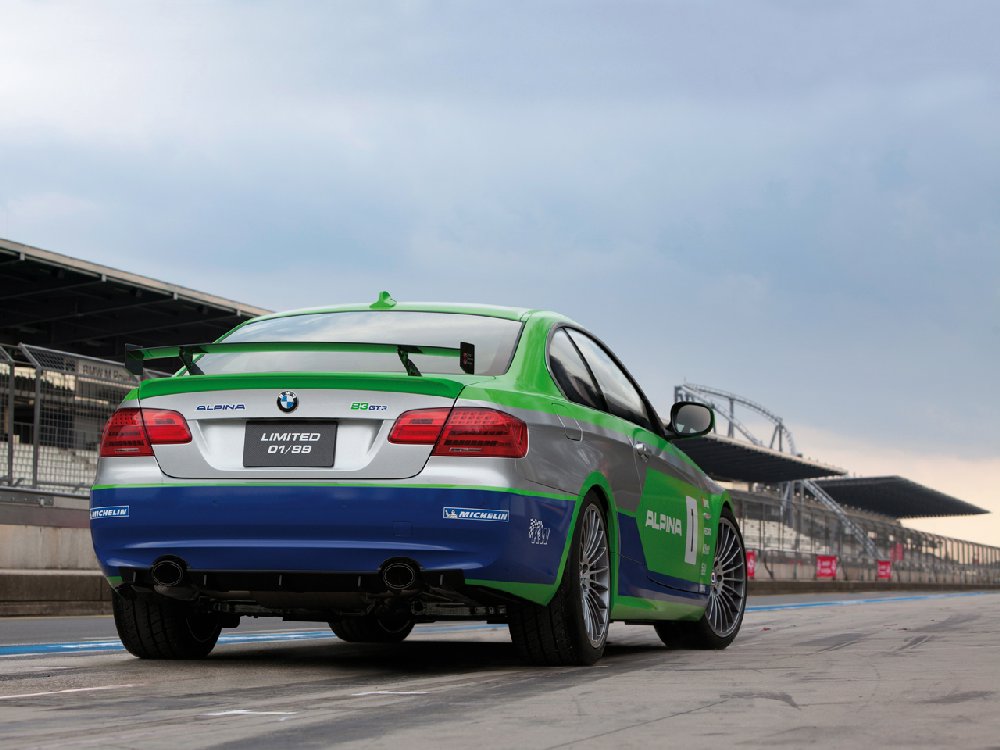
Visually, the B3 GT3 is distinguished by its front splitter and dramatic rear wing, both of which are made from carbon fibre. Together with a rear diffuser, it’s claimed that these new components have succeeded in eliminating all aerodynamic lift.
The interior features leather and Alcantara upholstery with heated Recaro front seats, while paintwork options are Black Sapphire metallic, Mineral White metallic or special Alpina Blue matt metallic.
Alternatively, those buyers wanting the full race-replica look can go for the optional B6 GT3 race car livery, which is achieved using an all-over vinyl wrap. Subtle it isn’t…
Exclusivity is one other thing that the B3 GT3 will have in its favour when sales begin in spring 2012, because only 99 examples are going to be built.
Perhaps less attractive is the price. In Germany it’s going to be approximately €90,000 including VAT, or roughly £77,180 / US$121,500 at today’s exchange rates. That would make it over 40% more expensive than a BMW M3, which currently retails for £54,690 in the UK.
Related posts:
Alpina B5 UK sales start
Alpina B3 S Bi-Turbo
As the ‘B3’ part of the name implies, the BMW 3 Series Coupé is the starting point for this new model, rather than the 6 Series which the race car is based on.
The running gear is typically Alpina, and comprises a twin-turbo version of BMW’s straight-six 3.0 litre engine connected to a six-speed automatic gearbox. Thanks in part to a lightweight titanium exhaust system from Akrapovic, power output is 402 bhp (300 kW / 408 PS), while peak torque is a huge 540 Nm (398 lb/ft).
By comparison, the normally aspirated BMW M3 with its 4 litre V8 produces 414 bhp (309 kW / 420 PS) and 400 Nm (295 lb/ft) of torque.
So how do those two very different drivetrain configurations measure up in terms of performance?
Fit the M3 with the optional seven-speed double clutch transmission and it shares an identical 4.6 seconds 0-62 mph (100 km/h) time with the B3 GT3. However, as far as top speed is concerned, an electronically-limited 155 mph (250 km/h) for the BMW can’t compete with the Alpina’s unrestrained 186 mph (300 km/h).
Another area where the B3 GT3 wins is efficiency - it achieves a combined cycle consumption figure of 29.4 mpg (9.6 l/100km) and emits 224 g/km of carbon dioxide. Conversely, the M DCT-equipped M3 manages 25.2 mpg (11.2 l/100km) and 263 g/km.
But the B3 GT3 isn’t just about its engine, because the influence of the B6 GT3 extends to other areas too. For instance, the suspension set-up features fully adjustable coilovers and dampers that allow the driver to tweak the handling to suit their own personal preferences. The brakes meanwhile have 6- and 4-piston calipers at the front and rear respectively, and these have been matched to enlarged brake discs.
The 20-spoke, 19” forged alloy wheels come in the Alpina’s trademark ‘Classic’ design, but they’re 25% lighter than usual. Standard equipment is Michelin Pilot Sport 2 tyres, although for track day enthusiasts the optional ‘GT3 Cup’ wheel and tyre set features Michelin Pilot Sport Cup+ rubber. Those tyres are still street legal, but their higher operating temperature requirement and poor wet weather capabilities mean that even Alpina doesn’t recommend them for everyday road use.
Visually, the B3 GT3 is distinguished by its front splitter and dramatic rear wing, both of which are made from carbon fibre. Together with a rear diffuser, it’s claimed that these new components have succeeded in eliminating all aerodynamic lift.
The interior features leather and Alcantara upholstery with heated Recaro front seats, while paintwork options are Black Sapphire metallic, Mineral White metallic or special Alpina Blue matt metallic.
Alternatively, those buyers wanting the full race-replica look can go for the optional B6 GT3 race car livery, which is achieved using an all-over vinyl wrap. Subtle it isn’t…
Exclusivity is one other thing that the B3 GT3 will have in its favour when sales begin in spring 2012, because only 99 examples are going to be built.
Perhaps less attractive is the price. In Germany it’s going to be approximately €90,000 including VAT, or roughly £77,180 / US$121,500 at today’s exchange rates. That would make it over 40% more expensive than a BMW M3, which currently retails for £54,690 in the UK.
Related posts:
Alpina B5 UK sales start
Alpina B3 S Bi-Turbo
Subscribe to:
Posts (Atom)